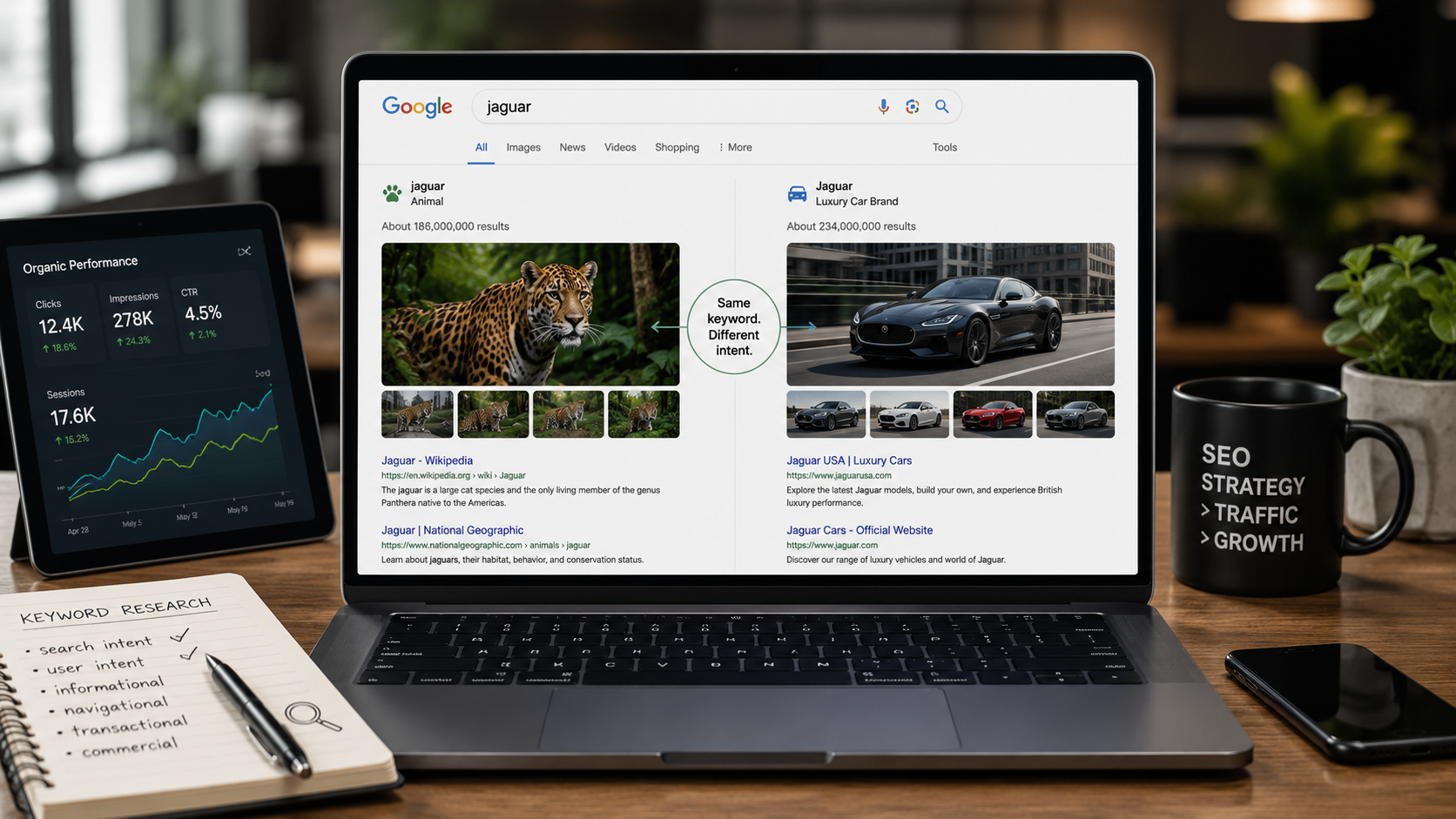
Two people type “jaguar” into Google. One wants the animal. The other wants the car. Same word, two completely different goals. Search intent is the real question hiding behind the words, and it decides which page Google shows each of them. Get it right and you rank. Get it wrong and no amount of keywords will save you.
- What is search intent?
- Why search intent matters for SEO
- The 4 types of search intent
- Search intent examples (keyword by keyword)
- How to identify the search intent behind a keyword
- How to optimize your content for search intent
- Search intent in the age of AI Overviews and AEO
- Common search intent mistakes to avoid
- Get help matching your content to search intent
- Frequently asked questions
What is search intent?
Search intent (also called user intent or keyword intent) is the goal behind a search query: the reason someone typed it and what they hope to find. Every Google search is a question or a task, and search engines rank the pages that best satisfy that goal, not just the pages that repeat the keyword.
You will also see it called audience intent. The label matters less than the idea: behind every query is a person trying to do something specific.
Think of it like ordering at a restaurant. The words on the menu matter, but the waiter’s job is to bring what you actually want. Google is the waiter. If you ask for a definition and it hands you a checkout page, it did its job badly, and it knows it.
Why search intent matters for SEO
Google ranks pages on relevance, and relevance is mostly about intent. When your content matches the goal behind a query, it earns the spot. When it doesn’t, it slips, no matter how strong the page looks on paper.
Google says this plainly. “Does your content match intent?” sits among the self-assessment questions in its helpful content guidance for creators. Matching intent against the query is treated as a central ranking criterion in most practitioner guides too, including Ahrefs’ search intent guide.
Miss the intent and you can have the best backlinks in your niche and still not rank. Visitors land, see the wrong kind of page, and bounce straight back to Google. That pattern, called pogo-sticking, tells search engines your page did not answer the question.
There is a business side too. The right intent brings traffic that converts instead of traffic that just visits. A page that meets the searcher where they are is how you turn rankings into leads and increase organic traffic that actually pays off.
The 4 types of search intent
Almost every query falls into one of four types: informational, navigational, commercial, and transactional. Learn to spot them and you can predict what Google wants to show before you write a single word. Most keywords sit cleanly in one type. A few are mixed, which we will cover later.
Informational intent
The user wants to learn something or answer a question. These queries lean on modifiers like “how,” “what,” “why,” “when,” “guide,” and “tutorial.” Examples: “what is search intent” (yes, the query that brought you here) or “how does SEO work.”
Informational is the biggest bucket by far. It is widely cited that around 70% of all searches are informational (Neil Patel), though more recent analysis puts the figure closer to 57% of Google queries (Ahrefs). Either way, it dominates. The ideal format is a blog post or a guide.
Navigational intent
The user is looking for a specific site or page. They already know where they want to go and use search as a shortcut. Examples: “yoast login,” “semrush pricing,” or any brand name typed straight into the search bar.
One practical note: it rarely makes sense to chase navigational queries for a brand you do not own. Someone searching “semrush login” wants Semrush, not your comparison post.
Commercial intent
The user is researching before a purchase. They want to buy eventually, but they are still comparing options. Modifiers give it away: “best,” “top,” “review,” “vs,” and “comparison.” Examples: “best SEO tools” or “Semrush vs Ahrefs.”
These searchers reward pages that help them decide. The ideal format is a comparison, a listicle, or an in-depth review that lays out real trade-offs instead of a sales pitch.
Transactional intent
The user is ready to act, usually to buy or sign up. The query signals a decision already made. Modifiers include “buy,” “price,” “cheap,” “discount,” “coupon,” and “near me.” Examples: “buy SEO software” or “SEO agency near me.”
Serve these searchers a product page, a service page, or a focused landing page. A long explainer here just gets in the way of the thing they came to do.
Search intent examples (keyword by keyword)
Intent is easier to see with real keywords. Each one below belongs to a type, and that type dictates the page format Google rewards. If your page format does not match the right-hand column, you will struggle to rank no matter how good the writing is.
| Keyword | Search intent | Page type Google rewards |
|---|---|---|
| what is search intent | Informational | Guide / blog post |
| how to add schema markup | Informational | Tutorial / how-to |
| meta description length | Informational | Guide with a quick answer |
| yoast login | Navigational | Specific site page |
| schemafy blog | Navigational | Brand page |
| best seo plugins for wordpress | Commercial | Listicle / comparison |
| semrush vs ahrefs | Commercial | Head-to-head comparison |
| buy seo software | Transactional | Product / pricing page |
| seo agency near me | Transactional | Local service / landing page |
| wordpress hosting coupon | Transactional | Deals / pricing page |
Read the table top to bottom and the pattern is clear: the words tell you the goal, and the goal tells you the page.
How to identify the search intent behind a keyword
You do not have to guess. The SERP is the source of truth, because Google has already classified the intent for you and ranked the results that prove it. Here are three ways to read it, from most reliable to least.
Analyze the SERP
Type the keyword into Google and look at what dominates the first page. This is the most direct signal you have, because Google has already done the classification work (Search Engine Land). If the top 10 are guides and blog posts, the intent is informational. If they are product and pricing pages, it is transactional. If comparison articles rank, it is commercial.
SERP features are signals too. People Also Ask boxes and featured snippets point to informational intent. Shopping carousels point to transactional. A local pack means Google reads a “near me” goal even if you did not type those words.
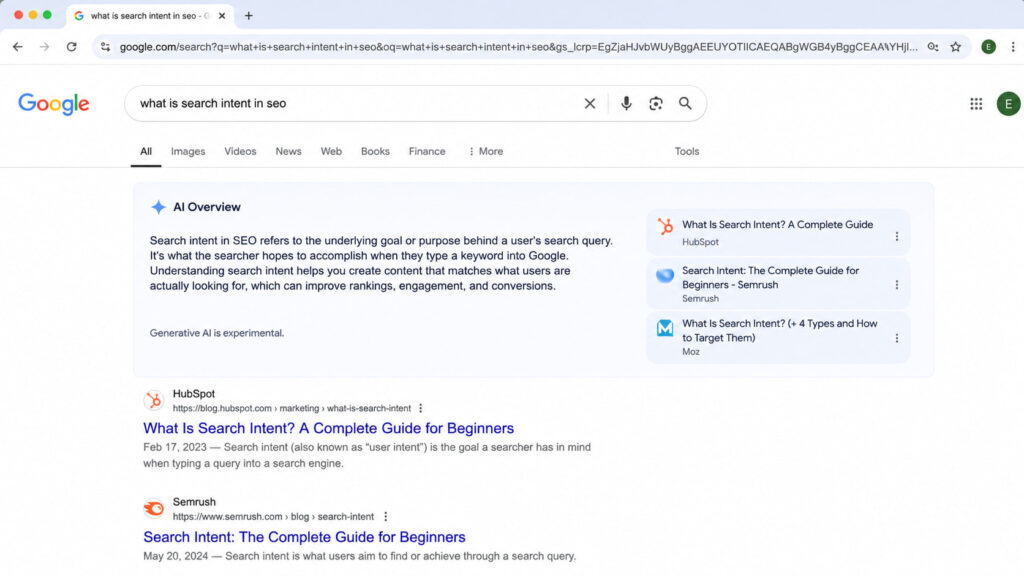
Google’s own SERP is the clearest intent signal: guide-style results and a People Also Ask box mark this as an informational query.
Read the modifiers in the query
The extra words around your main keyword reveal the likely intent before you even open Google. Use this as a quick first read, then confirm with the SERP.
| Modifier | Likely intent |
|---|---|
| how, what, why, guide, tutorial | Informational |
| best, top, review, vs, comparison | Commercial |
| buy, price, cheap, coupon, discount, near me | Transactional |
| brand name, login | Navigational |
One rule keeps you honest: SERP evidence overrides the modifier (Ahrefs). If the words say one thing but the ranking pages say another, believe the pages.
Use a keyword tool’s intent labels
Tools like Ahrefs and Semrush now tag intent for you automatically, which is handy when you are sorting hundreds of keywords at once. The same is true of newer AI SEO tools that add intent scoring. Treat these labels as a starting point, not a verdict. A tool guesses from patterns; the live SERP shows what Google actually decided. Always validate against the real results.
How to optimize your content for search intent
Once you know the intent, three moves align your page with it. None of them require a rewrite from scratch.
Match the content type and format
Give the searcher the format their intent expects. A guide for informational queries. A comparison for commercial ones. A product or landing page for transactional ones. The single most common mistake in SEO is publishing a blog post for a transactional keyword, then wondering why a page full of product results outranks it. The content type has to match before anything else you do matters.
Cover the whole topic (content depth)
Answer the main question, then answer the questions around it. People Also Ask boxes are a free checklist of the subtopics Google associates with your query, so mine them and cover what is missing. Keep your headings clear and scannable so a reader can confirm in seconds that your page solves their search. Depth is not word count. It is coverage of what the searcher actually needs.
Align title tags and meta descriptions
Your title tag and meta description are the first intent check a searcher runs, right there in the results. They should reflect the goal and promise the outcome, which lifts click-through rate and reinforces relevance. It also helps to see how the snippet looks before you publish. A no-code plugin like Schemafy lets you edit the meta title and description and preview your snippet the way Google shows it, so you can match the wording to intent without touching code. If you are unsure how much these tags move the needle, here is the reality on meta descriptions and CTR and how to add a meta description in WordPress.
Search intent in the age of AI Overviews and AEO
Search intent is shifting under our feet. More and more informational queries now get answered inside the SERP itself through AI Overviews, so a growing share of searches end without a click. The old goal, rank first, is no longer the whole game.
The new goal is to be the source the AI cites. That means writing answer-first: lead with a direct answer, back it with concrete data, and name your entities clearly so a language model can lift and attribute your point. Structured data helps here, which is why schema markup is becoming table stakes for AI search.
Intent itself is expanding. SE Ranking now lists a sixth type, generative AI intent: queries where the user expects a synthesized answer from an AI engine rather than a list of links (SE Ranking). Optimizing for it has its own name, Answer Engine Optimization, and it overlaps heavily with generative engine optimization. The core skill has not changed. You still start by understanding what the searcher wants. You just have one more surface to satisfy.
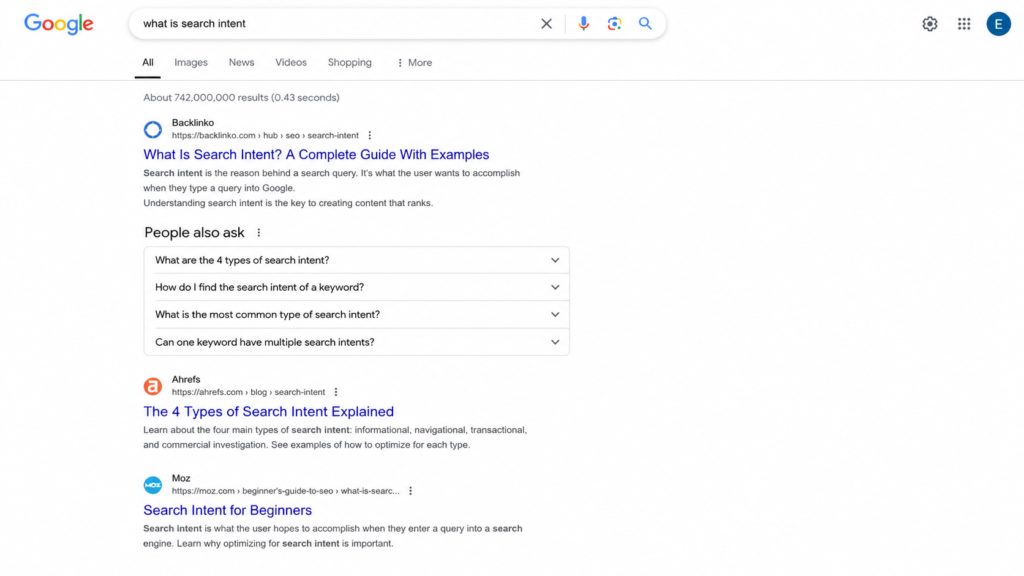
Informational intent increasingly resolves inside the SERP: an AI Overview answers the query before the user reaches a single organic link.
Common search intent mistakes to avoid
Most intent problems come down to the same handful of errors:
- Forcing transactional keywords into blog posts. If Google ranks product pages, an article will not win the spot.
- Ignoring the SERP and guessing. Your assumption about intent loses to the pages already ranking. Check first.
- Mixing multiple intents on one page. Trying to inform and sell in the same breath usually does neither well.
- Publishing thin content for informational keywords. Informational SERPs reward depth, and a 300-word skim gets buried.
- Not updating when the SERP shifts intent. Intent changes over time. A keyword that was informational last year may be commercial now, so re-check your winners.
Get help matching your content to search intent
Aligning your title tags and meta descriptions with intent is where a lot of pages quietly win or lose their click-through. It is a small edit with an outsized effect on how well your snippet matches what the searcher wants.
If you would rather not hand-code any of it, a no-code plugin like Schemafy lets you rewrite meta titles and descriptions and preview the snippet the way Google displays it, so you can tune the wording to intent in a few minutes.
Frequently asked questions
What are the 4 types of search intent?
The four types of search intent are informational (learning something), navigational (finding a specific site), commercial (researching before a purchase), and transactional (ready to buy or act). Each maps to a different content format, so matching the right type is key to ranking.
How do I find the search intent of a keyword?
The most reliable way is to type the keyword into Google and study the top results. If they are guides, the intent is informational; if they are product pages or listicles, it is transactional or commercial. Query modifiers and keyword-tool intent labels help confirm.
What is the most common type of search intent?
Informational intent is the most common, accounting for roughly 70% of all searches. These users want to learn or answer a question, using modifiers like “what,” “how,” and “why.” That is why guides and blog posts dominate informational SERPs.
Can one keyword have multiple search intents?
Yes. Some keywords are ambiguous and show mixed results in the SERP, part informational, part commercial. Google hedges by ranking a blend of formats. In those cases, review the SERP and match the dominant intent while covering secondary angles.
Final thoughts
Search intent, not the keyword itself, is what decides whether you rank. The page that best satisfies the goal behind the query wins, and everything else you do in SEO is downstream of that one match. Backlinks, word count, and clever titles only pay off once the intent is right.
So before you write your next piece, open Google, read the SERP for your target keyword, and commit to a single intent type. Match the format, cover the topic, and align your title and meta description to what the searcher actually wants. Then re-check that same SERP in a few months, because intent shifts over time, and the page that keeps matching it is the page that keeps ranking.
[CTA_DOWNLOAD]
Leave a Reply