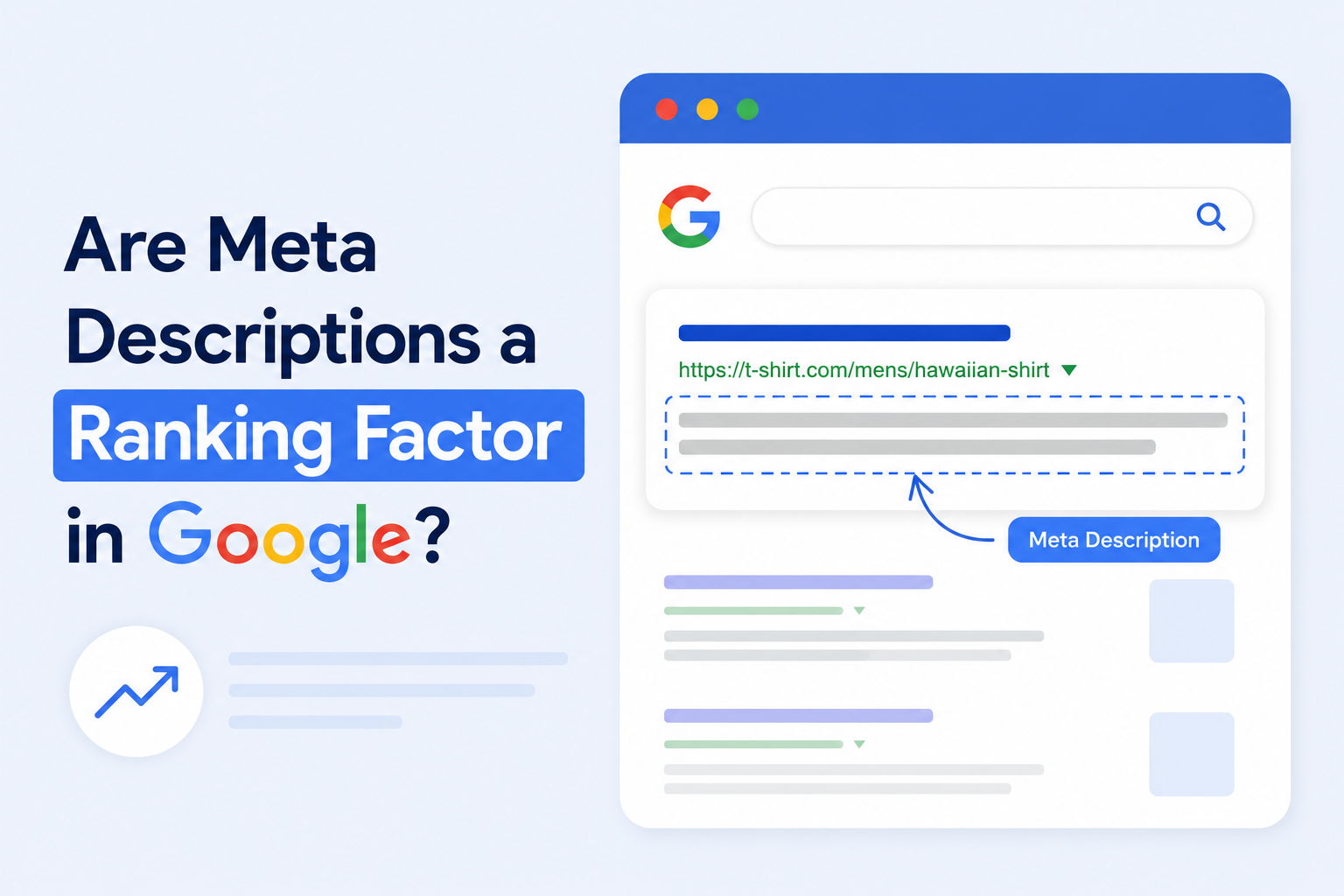
Plenty of SEO advice treats the meta description like a ranking lever: write the perfect one and watch your page climb. Google has said, on the record and more than once, that it doesn’t work that way. Meta descriptions don’t move your rank. They do something else, and that something is still worth your time.
What Are Meta Descriptions?
A meta description is a short summary of a page, usually a sentence or two, that search engines can show beneath your page title in the results. Think of it as a one-line elevator pitch for the page: it doesn’t decide whether you show up, it helps decide whether someone clicks once you do.
It’s the text that can become your snippet (the gray description line under a search result). WordPress and most content systems don’t write one for you. Leave it blank and the search engine pulls whatever text it can find on the page, often the first sentence it sees, and uses that instead.
Where Meta Descriptions Appear in Google Search
Meta descriptions live in the search snippet: the title, the URL, and the description line that sit together in a result. On desktop, Google typically shows around 155–160 characters before it truncates with an ellipsis; on mobile, the cut comes earlier, around 120 characters (Ahrefs).
That visible space is small and contested. Your description is competing with nine other snippets on the page for the same click, so the part the reader actually sees, the first half, carries most of the weight.
The Difference Between Meta Descriptions and Meta Keywords
These two get confused constantly, and the distinction matters. The meta keywords tag is dead. Google stopped using it for ranking because it was so easily stuffed with terms the visitor never saw. Google announced in 2009 that it disregards the keywords meta tag in web ranking precisely because of that abuse.
The meta description tag is alive and useful. Google still reads it and may use it for your snippet. It just isn’t a ranking factor either. Same announcement, two different tags: one ignored entirely, one used for snippets but not for rank.
Does Google Use Meta Descriptions as a Ranking Factor?
No. Google has confirmed in its official documentation that meta descriptions are not a ranking factor. They don’t affect where your page ranks. Google uses them to help build the search snippet shown under your title, which can influence whether people click, but not your position in the results.
Ranking is decided by other things: content relevance, links, page quality, and the dozens of signals Google weighs to match a page to a query. The meta description sits outside that process. Google’s own SEO Starter Guide states plainly that the description meta tag “will have no effect on your rankings,” while noting a good one can produce a better snippet.
Not a ranking factor is not the same as not important, though. The rest of this article is about the difference.
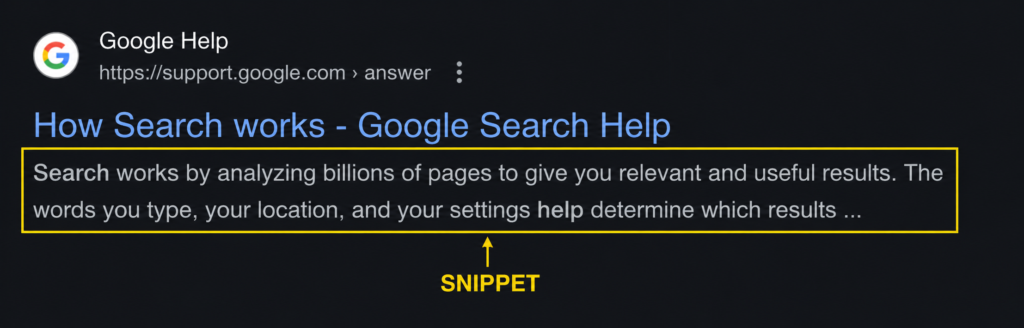
A standard Google result. The highlighted description line is the snippet, the part a meta description can fill, but not the part that decides rank.
What Google Officially Says About Meta Descriptions
Google Search Central describes the meta description as a summary the search engine may use to generate the snippet. The key statement is from 2009 and has held since: “even though we sometimes use the description meta tag for the snippets we show, [Google doesn’t] use the description meta tag in … ranking” (Google Search Central Blog).
Google’s current guidance on writing meta descriptions reinforces the same split: the description’s job is the snippet, and the snippet’s job is to help users decide what to click.
Google Documentation About Meta Descriptions and Rankings
The page to read is Search Central’s “How to Write Meta Descriptions,” which sits under Google’s documentation on search appearance and snippets. It covers how Google builds snippets and how to write descriptions that earn them, not how descriptions affect rank, because they don’t.
Google’s list of meta tags it supports tells the same story by omission: the description tag and robots directives are there; the keywords tag isn’t.
What Matt Cutts Said About Meta Descriptions
Matt Cutts, who led Google’s Webspam team for years, reinforced the official position publicly: meta descriptions aren’t a ranking signal. His practical advice went a step further: he said that having no meta description is better than having a duplicate one across many pages, and that if you’re short on time, you should prioritize the descriptions on your homepage and most important pages (Search Engine Journal).
That’s a useful prioritization rule, not a ranking claim. It’s about where your limited effort earns the most clicks.
Are Meta Descriptions Used for Rankings or Just Snippets?
Just snippets. Their entire role is to shape the description line in the SERP, the text that helps a searcher decide whether your result is the one worth clicking. Rankings are decided elsewhere. Which raises the obvious question: if they don’t help rankings, why write them at all?
Why Meta Descriptions Still Matter for SEO
Because the meta description is the biggest lever you control over your snippet, and the snippet is what earns the click your ranking already won. Ranking gets you onto the page of results. The snippet decides whether anyone chooses you over the nine other options.
That’s the whole case. You can’t directly raise your rank with a description, but you can directly change how appealing your result looks, and that changes how many of your impressions turn into visits.
Writing a description blind, without seeing how it renders, is where most of them go wrong. A live snippet preview removes the guessing: Schemafy’s Google Preview and standalone tools like a free SERP preview tool show the snippet, with truncation, before you publish.
How Meta Descriptions Improve Click-Through Rate (CTR)
Position still dominates click-through rate, but it isn’t the whole story. Backlinko’s analysis of 4 million results found the first organic position earns about a 27.6% click-through rate, dropping to 18.7% at position #2, 10.2% at #3, and 2.2% by position #10 (Backlinko). Within any given position, the snippet (title, URL, and description) is part of what wins or loses the click.
A specific, benefit-led description beats a generic one at the same rank. Here’s the contrast.
| Snippet quality | Example | Why it wins or loses |
| Strong | “Compare 7 running shoes for flat feet: arch-support scores, durability tests, and current prices.” | Specific, benefit-led, opens with an action verb, fits before truncation |
| Weak | “This blog post talks about running shoes for people with flat feet and other things.” | Vague, no benefit, no reason to pick it over the result above |
Can Better CTR Improve SEO Performance Indirectly?
Maybe, and this is where honesty matters. Google has been careful not to call organic CTR a direct ranking signal in the classic sense, and it’s easy to manipulate, so treat any “higher CTR ranks you higher” claim with caution. What’s clearer is the traffic math: Backlinko found that moving up a single position lifts CTR by about 2.8% on average (Backlinko).
So a better description won’t push you up the page, but it can help you capture more of the clicks available at the position you already hold. That’s a real outcome without overclaiming a ranking effect.
Why Meta Descriptions Help Users Understand Page Content
A clear description sets expectations before the click. When the snippet matches what’s on the page, the people who click are the people who actually wanted that page: better-qualified visitors who are less likely to bounce straight back. A description that oversells or misleads does the opposite: it earns a click and loses the visitor seconds later.
Does Google Rewrite Meta Descriptions?
Yes, and more often than most people expect. An Ahrefs study of roughly 20,000 keywords found Google rewrites the meta description about 62.78% of the time, and shows the description you wrote only around 37% of the time (Ahrefs, 2020).
A rewrite is not a penalty. It’s Google deciding that, for a specific query, a passage pulled from your page describes the result better than your hardcoded line. The fix isn’t to fight it; it’s to write descriptions Google has less reason to replace.
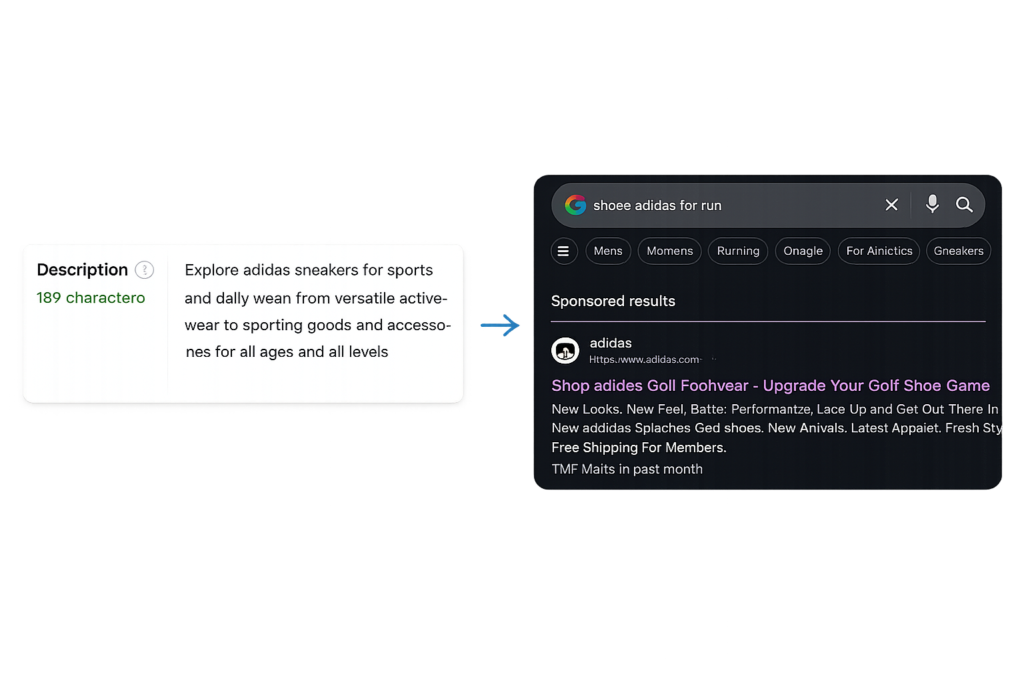
A hardcoded meta description (left) versus the snippet Google generated for a more specific query (right). Rewrites are common and query-driven.
Why Google Rewrites Meta Descriptions
Two main reasons. First, the searcher’s query is more specific than your description, so Google generates a snippet that surfaces the exact words they searched for. Second, your description doesn’t match the page well, so Google pulls a more relevant passage instead. The rewrite rate even shifts by query type: about 59.65% for short head terms and 65.62% for long-tail queries (Ahrefs, 2020), because long-tail searches are more specific and invite more query-matching.
How Often Google Ignores Custom Meta Descriptions
Often enough that you should expect it, not be surprised by it. The same 2020 study put the rewrite rate near 63% across ~20,000 keywords, with your written description showing roughly 37% of the time (Ahrefs). That’s still one in three impressions where your words do the talking, reason enough to write them well rather than skip them.
What Happens When a Page Has No Meta Description
Google generates one for you. It scans the page and pulls a passage, frequently the opening text or whatever best matches the query, and uses that as the snippet. You don’t lose your ranking, but you do lose control of the message. The auto-generated line is rarely as compelling as one written to win the click, which is the whole point of writing one.
Do Long or Spammy Meta Descriptions Increase Rewrite Probability?
Length alone barely matters. Ahrefs found Google rewrote 61.46% of descriptions that were too long versus 63.69% of the rest, essentially the same (Ahrefs, 2020). Relevance and quality matter far more. A keyword-stuffed or off-topic description gives Google an easy reason to replace it; a clear, accurate one gives it a reason to keep it.
How to Write Meta Descriptions That Improve SEO Performance
Optimizing a meta description is a copywriting job with two SEO constraints: length and intent. Write for the human scanning the results, stay inside the visible space, and match what the page actually delivers. Five rules cover it. (If you’re working in WordPress, the mechanics of adding a meta description in WordPress are a separate, quick step.)
- Write a unique description for every important page.
- Use your keyword once, naturally, in the first half.
- Lead with a clear value proposition or call to action.
- Match the search intent of the page.
- Keep it inside the visible snippet length.
Write Unique Meta Descriptions for Every Important Page
Duplicate descriptions get ignored or rewritten, and they tell Google nothing useful about which page is which. Google’s own 2007 guidance on snippets asks for descriptions that differentiate each page. If you can’t write a unique one for every URL, do what Cutts advised: start with your highest-traffic pages. For a store with hundreds of product or category pages, uniqueness at scale is the real challenge, and the place templated, near-identical descriptions cause the most rewrites.
Use Keywords Naturally Without Keyword Stuffing
Place your target keyword once, ideally in the first half of the description. Google bolds query-matching words in the snippet, so an early, natural mention catches the eye. Repeating the keyword three times doesn’t help rank (descriptions aren’t a ranking factor), and it reads as spam, which costs you the click and invites a rewrite.
Add a Clear Value Proposition or CTA
Tell the reader what they get if they click, and open with a verb. “Learn how to fix WooCommerce schema in four steps” beats “This article is about WooCommerce schema.” Action verbs (Learn, Compare, Get, Build, Discover) read as direct, and a concrete promise outperforms a vague summary every time.
Match Search Intent and Page Content Accurately
Write the description to match the query the page targets and the content it actually delivers. The closer your description is to the search intent behind your keyword, the less reason Google has to rewrite it, and the more the click turns into a satisfied visitor rather than a bounce.
Recommended Meta Description Length
Aim for roughly 150–160 characters on desktop and around 120 on mobile, where truncation hits earlier (Ahrefs). Treat that as pixel-bound guidance, not a hard rule: Google measures width, not an exact character count. The practical move is to keep your value proposition in the first half so a cutoff never removes the part that earns the click. Writing with a SERP preview open makes the truncation point visible before you publish.
Common Meta Description Mistakes That Hurt SEO
“Hurt SEO” here means hurt your click-through rate and snippet quality, not your ranking. These mistakes won’t trigger a ranking penalty, but they will cost you clicks and invite rewrites. Four show up most often:
- Duplicate descriptions reused across many pages.
- Search-engine-only writing aimed at crawlers instead of readers.
- Over-optimized, keyword-stuffed copy.
- Misleading descriptions that don’t match the page.
Duplicate Meta Descriptions Across Multiple Pages
Reusing one description across many pages confuses snippet selection and almost guarantees a rewrite. It’s most painful for ecommerce sites, where hundreds of product and category pages often share a templated line. Each important page deserves a description that reflects its specific content.
Writing Meta Descriptions Only for Search Engines
A description written for a crawler, a list of keywords with no real sentence, reads as robotic to the human deciding whether to click. The snippet is a sales line shown to a person, not a field for the algorithm. Write it for the reader scanning ten results.
Over-Optimizing Meta Descriptions With Keywords
Stuffing the keyword multiple times doesn’t improve rank and actively lowers CTR, because it reads as spam. It also gives Google a reason to replace your description with something cleaner. One natural mention is plenty.
Using Misleading Meta Descriptions
A description that promises something the page doesn’t deliver earns the click and loses the visitor: they bounce, and Google often rewrites the misleading line anyway. Honest, accurate descriptions win clicks that stick, which is the only kind worth having.
Do Meta Descriptions Matter for Modern Search Features?
Search is no longer just ten blue links, so it’s fair to ask whether descriptions still earn their keep in AI Overviews, Discover, and large ecommerce results. The short answer: they help with visibility and clicks in these surfaces, but the evidence stops well short of a ranking effect. Where things are still evolving, it’s worth saying “may,” not “does.”
Meta Descriptions and AI Overviews
AI Overviews summarize content drawn from across the web, and clear, accurate page copy, including a well-written description, can only help a system trying to understand and represent your page. But there’s no confirmation that meta descriptions influence whether you appear in or rank within an AI Overview. Write them clearly because clarity helps every reader of your page, human or machine, not because of a confirmed AI ranking boost.
Meta Descriptions in Google Discover
Discover is a feed driven by user interests, not a query you can optimize a description against. Your title, image, and description support how clickable a Discover card looks, but they don’t determine whether you surface there; that’s about content quality and user signals. A strong description still helps the card earn the tap.
Meta Descriptions for Ecommerce and Category Pages
For WooCommerce/WordPress, descriptions are mostly a clickability and uniqueness problem at scale. Product and category pages serve transactional intent, where an auto-pulled snippet (a stray line of product spec text) sells poorly compared with a written line that names the benefit, the range, or the offer. The challenge is writing unique descriptions across a large catalog without falling back on a single template.
Are Meta Descriptions a Direct or Indirect Ranking Factor?
Direct? No, confirmed by Google. Indirect? At most, and only loosely, through click-through rate. The cleanest way to say it: a meta description is not a ranking factor, but it is a click factor, and clicks are downstream of rankings rather than upstream of them.
Direct Ranking Factors vs Indirect SEO Signals
A direct ranking factor is something Google’s algorithm weighs to decide position: content relevance, links, quality. An indirect signal is something that affects an outcome (like CTR or engagement) which may, in turn, relate to performance, without being a dial Google turns directly. Meta descriptions are, at most, an indirect signal: they shape the snippet, the snippet shapes CTR, and CTR is a contested, easily-gamed influence rather than a confirmed lever.
| Signal | Direct ranking factor? | How it affects SEO |
| Meta description | No | Shapes the snippet, which can influence CTR |
| Title tag | Not a strong direct factor | Influences relevance and CTR |
| Structured data | No | Enables rich-result eligibility, which lifts CTR |
| Content relevance and quality | Yes | A core ranking input |
What Meta Tags Google Actually Uses for Rankings
The honest list is short. The title tag carries real weight for relevance and heavily influences CTR. Robots and other meta directives control how Google crawls and displays a page; they don’t boost it. Structured data (the code that makes rich results, like star ratings, possible) doesn’t directly raise rank either, but it can earn eye-catching results that lift clicks.
Structured data is the piece many WordPress sites skip, because hand-writing JSON-LD is tedious. Tools handle it without code: a WordPress schema markup plugin or a standalone schema markup generator generates the markup for you. None of this changes the meta description’s status; it just clarifies which tags do the ranking work and which earn the click.
Final Verdict: Should You Optimize Meta Descriptions?
Yes, just for the right reason. A meta description is a click-side lever, not a ranking lever, and it’s worth writing well for the roughly one in three times Google actually shows it. Stop expecting it to move your rank, and start treating it as the sales line for your result.
The fastest place to start: take your highest-traffic pages, rewrite their descriptions with a snippet preview open so you can see exactly what Google will show, and match each one to the query the page targets. That’s a short exercise that compounds into better click-through over time.
Schemafy is one tool that helps you write and preview meta descriptions before they go live. Install it free from WordPress.org →
Frequently Asked Questions
Does Google officially say meta descriptions are not a ranking factor?
Yes. Google states in its official documentation that the description meta tag has no effect on rankings, and it confirmed back in 2009 that it doesn’t use the description meta tag in ranking. It’s used for snippets, not position.
Where in Google documentation does it say meta descriptions do not affect rankings?
Google’s SEO Starter Guide states the description meta tag “will have no effect on your rankings,” and Search Central’s snippet documentation explains that descriptions feed the snippet rather than the ranking algorithm.
Do meta descriptions affect Google rankings indirectly through CTR?
At most loosely. A better description can lift click-through rate, but Google has not confirmed organic CTR as a direct ranking signal, and it’s easily manipulated. Treat the link as plausible influence, not a guaranteed ranking effect.
What does Google Search Central say about meta descriptions?
Search Central describes the meta description as a summary Google may use to generate the snippet shown under your title. Its guidance focuses on writing unique, accurate, useful descriptions, for better snippets, not for ranking.
Are meta descriptions used for rankings or just search snippets?
Just search snippets. Their role is to shape the description line in the results, which helps a searcher decide whether to click. They play no part in deciding where your page ranks.
Why are meta descriptions important if they are not a ranking factor?
Because they’re the biggest lever you control over your snippet, and the snippet earns the click your ranking already won. A clear, specific description can win more of the clicks available at your current position.
Does Google rewrite meta descriptions in search results?
Frequently. An Ahrefs study found Google rewrites descriptions about 63% of the time, generating a snippet from page content when it judges that a better match for the query.
How often does Google ignore custom meta descriptions?
In the 2020 Ahrefs study of ~20,000 keywords, Google showed the provided description only around 37% of the time, meaning it rewrote or replaced it for roughly two-thirds of results. Your words still show often enough to be worth writing well.
Can better meta descriptions improve click-through rate?
Yes. Within a given ranking position, a specific, benefit-led description tends to out-click a vague one. The snippet, the title, URL, and description together, is part of what wins the click.
Do meta descriptions help SEO even if they are not ranking factors?
Yes, indirectly. They don’t raise rankings, but they improve click-through rate and set accurate expectations, which means more qualified visitors and fewer quick bounces from your search results.
Are title tags ranking factors while meta descriptions are not?
The title tag carries more weight: it influences relevance and strongly affects CTR, so it does more SEO work than a description. Neither is a simple ranking dial, but the title matters more to how Google understands and displays your page.
What is the difference between meta descriptions and meta keywords?
The meta keywords tag is deprecated. Google stopped using it for ranking in 2009 because it was abused. The meta description tag is still read and may be shown as your snippet, though it isn’t a ranking factor either.
Did Google ever use meta descriptions as a ranking signal?
There’s no reliable evidence Google has used meta descriptions as a ranking signal in the modern era of search. For as long as it has documented its position, Google has treated the description as snippet input, not a ranking input.
What did Google’s Matt Cutts say about meta descriptions and rankings?
Matt Cutts, Google’s former Webspam lead, confirmed descriptions aren’t a ranking signal and advised that no meta description is better than a duplicate one. He recommended prioritizing the homepage and most important pages if time is limited.
Do missing meta descriptions hurt SEO performance?
Not your ranking. A missing description means Google generates a snippet from your page text, so you lose control of the message and often get a less compelling line. It can soften click-through, but it won’t lower your position.
Should every page have a unique meta description?
Ideally, yes. Google asks for descriptions that differentiate each page. If you can’t cover every URL, prioritize the highest-traffic and most important pages first, and avoid reusing one line across many.
Can duplicate meta descriptions affect SEO?
They don’t cause a ranking penalty, but they hurt snippet quality and are more likely to be rewritten. Duplicate descriptions also make your results less distinct, which can lower click-through on the pages that share them.
Does Google generate its own snippets instead of using meta descriptions?
Often. Google builds a snippet from page content when it thinks that better matches the query, which is why your written description appears only about a third of the time. A well-matched description reduces how often that happens.
Do meta descriptions help Google understand page content?
They’re a minor signal of relevance at best, not a tool for ranking comprehension. Google understands your page mainly from its content and structure. A clear description helps users understand the page, which is its real value.
What meta tags does Google actually use as ranking factors?
Very few tags act as ranking factors. The title tag influences relevance and CTR; robots and directive tags control crawling and display without boosting rank. The description and keywords tags aren’t ranking factors at all.
Are meta descriptions important for AI Overviews?
They may help by giving AI systems clear, accurate copy about your page, but there’s no confirmation that meta descriptions influence whether you appear in or rank within an AI Overview. Write them clearly regardless; clarity helps every reader.
Do meta descriptions matter for Google Discover?
They support how clickable a Discover card looks, alongside the title and image, but they don’t determine whether you surface in Discover. That’s driven by content quality and user interest signals, not by optimizing a description.
Can meta descriptions improve organic CTR?
Yes, this is their main practical benefit. A specific, well-written description makes your result more appealing than a generic one at the same position, which can lift the share of impressions that turn into clicks.
What is the ideal meta description length according to Google?
Google doesn’t publish a fixed character limit; snippets are width-based. As a practical guide, aim for about 150–160 characters on desktop and around 120 on mobile, and keep the most important words in the first half.
Does Google documentation recommend writing unique meta descriptions?
Yes. Google’s guidance on snippets recommends unique, accurate descriptions that differentiate each page, rather than a single description reused across the site.
Are meta descriptions a direct or indirect ranking factor?
Not a direct ranking factor; Google has confirmed this. At most they’re an indirect influence, through the click-through rate a better snippet can earn. They shape clicks, not position.
Can spammy meta descriptions hurt SEO?
They can hurt your click-through rate and increase the odds Google rewrites them, but they won’t trigger a ranking penalty by themselves. Stuffed or misleading descriptions read as low-quality and undermine trust before the click.
Do ecommerce category pages need meta descriptions?
They benefit from unique, written descriptions because they serve transactional intent, where an auto-generated snippet often reads poorly. The challenge is writing distinct descriptions across many similar category and product pages without a single template.
How should you optimize meta descriptions for SEO?
Write a unique description per important page, include the keyword once and naturally, lead with a clear benefit, match the page’s search intent, and keep it inside the visible snippet length. Preview the snippet before publishing so you can see truncation.
What happens if a page has no meta description?
Google auto-generates a snippet from your page content, usually the opening text or a passage matching the query. You keep your ranking but lose control of the message, and the generated line is rarely as persuasive as one you write yourself.
Leave a Reply