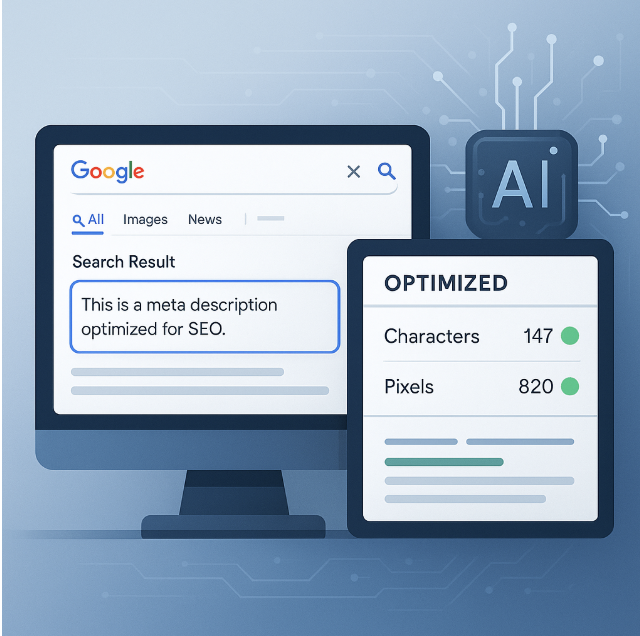
When you’re trying to improve your website’s visibility in search results, meta descriptions might seem like small details, but they play a surprisingly powerful role in whether people actually click through to your site.
Think of your meta description as your website’s elevator pitch in search results, you have just a few seconds to convince someone that your page has exactly what they’re looking for.
Common meta description problems include:
- Your description gets cut off in Google results
- Your message is too short and wastes valuable space
- Google rewrites your description completely
- You’re unsure what length actually works
In this guide, you’ll learn:
- The ideal meta description length in 2026
- How Google decides what snippet to show
- How to write descriptions that improve CTR
- Common mistakes that reduce search performance
What Is a Meta Description?
A meta description is a short snippet of HTML code that summarizes what a webpage is about. You can think of it as a preview that lives in the background of your page, visitors don’t see it when they’re actually on your site, but search engines pull this information to display in their results.
Why It Matters for SEO
Here’s an important distinction: meta descriptions aren’t a direct ranking factor. Google has been clear about this, the text in your meta description won’t make your page rank higher or lower in search results.
However, meta descriptions have a strong indirect impact on SEO because they influence click-through rate (CTR).
When a meta description is clear and compelling:
• More users click on your result
• Higher CTR signals relevance to search engines
• Your content appears more valuable to Google
• Over time, this can support stronger rankings
Where It Appears in Google Search Results
Each Google search result typically includes three main elements:
- Page title (blue clickable text)
- URL
- Meta description (gray text below the title)
The meta description usually spans two to three lines and expands on the promise made in the page title.

Its Role in Click-Through Rate (CTR)
Imagine two search results with identical rankings and similar titles, but one has a well-crafted meta description while the other displays a generic snippet.
The result with the better description will typically receive significantly more clicks, studies show that well-optimized meta descriptions can increase CTR by up to 5.8% compared to poorly optimized competitors.
This happens because people are scanning search results quickly, looking for signals that a page will satisfy their needs. Your meta description provides context and reassurance, it answers the implicit question in every searcher’s mind: “Is this worth my time?”
The Ideal Meta Description Length in 2026
Now we arrive at the heart of the matter: how long should your meta descriptions actually be? The answer is more nuanced than you might expect, and understanding the technical constraints alongside practical considerations will help you optimize effectively.
Recommended Character and Pixel Limits
| Device | Character Limit (approx.) | Pixel Limit (approx.) | Description |
| Desktop | 155-160 characters | 920 pixels | Recommended length for optimal display on desktop |
| Mobile | 155-160 characters | ~920 pixels | Mobile devices may show slightly more characters, but still within the same pixel width |
| Important | 120 characters (start of the description) | ~650 pixels | Focus your most important message here to ensure it’s visible across all devices |
In practical terms, you want to aim for approximately 155-160 characters, but more precisely, you should stay within about 920 pixels of width.
Research from Ahrefs confirms that this length ensures proper display across devices while maximizing the space available to communicate your message. Desktop and mobile displays have slightly different constraints, with mobile sometimes allowing a bit more space since the text wraps across more lines.
How Google Decides What to Display
| Criteria | Description |
| Provided Meta Description | If relevant to the search query, it’s likely to be displayed in full. |
| Text Pulled from Page Content | If the provided meta description doesn’t match the search query, Google may rewrite it using content from the page that matches better. |
| Frequency of Rewriting | Google rewrites meta descriptions approximately 63% of the time, based on query relevance and available content. |
Google decides what description to show based on the search query.
For example:
- If your meta description matches the search query → Google usually displays it.
- If it doesn’t match well → Google may pull text directly from the page instead.
- Google aims to show the snippet most helpful to the searcher.
Research from Ahrefs shows Google rewrites meta descriptions about 63% of the time.
Why There’s No “Perfect” Length for Every Page
| Page Type | Ideal Meta Description | Reason |
| Homepage | Broader description highlighting the brand’s core value proposition | Communicates the brand’s general value for all users |
| Product Page | More specific description emphasizing product features and benefits | Needs to highlight key features and benefits of the product |
| Blog Post | Detailed and specific description summarizing what the user will learn | Users are looking for answers to specific questions |
| Landing Page | Concise, action-oriented description, like “Buy Now” or “Get a Free Consultation” | Needs to drive immediate action |
The ideal meta description length can vary depending on the page type.
For example:
- Landing pages use concise, action-focused messaging
- Homepages use broader descriptions highlighting the brand’s value
- Product pages emphasize product features and benefits
- Blog posts summarize what the reader will learn
What Happens If It’s Too Long or Too Short?
Truncated Meta Descriptions: Why They Hurt CTR
| Meta Description Length | Issue | Impact |
| Too Long (Truncated) | Text gets cut off with ellipsis “…” | Missing key information, potentially harms CTR (click-through rate) |
| Too Short | Missed opportunities to include valuable context | Fails to convince searchers to click, limits keyword inclusion and competitive edge |
Truncation can damage how professional your result appears in search results.
Common problems include:
- Key information getting cut off
- Important calls-to-action disappearing
- Sentences ending abruptly
- Descriptions appearing incomplete or unprofessional
These issues can reduce trust and lower click-through rates.

The impact on click-through rates is significant, studies show that well-optimized meta descriptions can increase CTR by up to 5.8% compared to poorly written or truncated descriptions.
Short Meta Descriptions: Missed SEO Opportunities
When you only use 80 or 90 characters when you could comfortably fit 150, you’re leaving opportunities on the table. Search results are competitive, and every piece of available space is a chance to communicate value and persuade people to choose your result.
Example:
Too short: “Find eco-friendly kitchen storage options.”
Optimized: “Find eco-friendly kitchen storage from bamboo to glass and stainless steel. Shop our best-selling collection and reduce plastic waste today.”
The optimized version mentions specific benefits, product variety, and creates urgency, all within the character limit.
How to Write the Perfect Meta Description
Focus on Intent and Relevance
| Element | Description | Optimization Tip |
| Focus on Intent | Understand why someone is searching and align your description to meet their needs | Ensure the description immediately shows how your page fulfills their search |
| Include Primary Keyword | Use the target keyword naturally within the description | Avoid keyword stuffing; use synonyms for variety |
| Clear Value Proposition | Explain what makes your page unique or beneficial | Highlight specific benefits, outcomes, or features |
| Call to Action | Use action-driven language to encourage user interaction (e.g., “Shop Now,” “Learn More”) | Use strong verbs that push the user to take action immediately |
Start by thinking about the questions or problems your target audience has. If you’re writing about meal planning, your audience probably feels overwhelmed by weekly cooking, wants to save time, or is trying to eat healthier.
Weak: “This article talks about meal planning tips”
Strong: “Learn a simple meal planning system that saves 5+ hours weekly and reduces grocery costs by 30%”
The strong version addresses underlying needs and desired outcomes.
Include the Main Keyword Naturally
Keywords in meta descriptions serve two important purposes:
- Google bolds matching search terms in the snippet
- This makes your result more visible in search results
- Keywords reinforce what your page is about
- They help users quickly see that your page matches their search
The key: Include keywords naturally. Keyword stuffing makes your description read like it was written by a robot.
Stuffed: “Best pizza NYC, NYC pizza delivery, order pizza in NYC for the best NYC pizza”
Natural: “Our project management software helps small teams collaborate effectively without the complexity of enterprise tools”
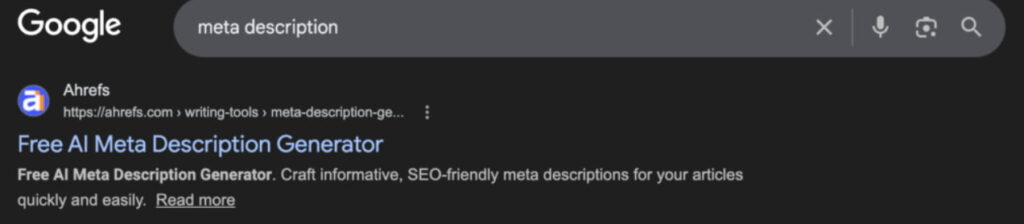
As explained in Google’s guidance on improving snippets, using descriptive and accurate meta descriptions helps users identify relevant results quickly. This visual emphasis makes your result more noticeable and signals strong relevance to the searcher’s query.
Examples of Good Meta Descriptions
| Industry | Meta Description Example | Why It Works |
| E-commerce (Running Shoes) | “Find lightweight running shoes engineered for marathon training and daily runs. Free shipping on orders over $75, 60-day comfort guarantee.” | Addresses product features, benefits, and offers incentives |
| Software (Project Management Tool) | “Streamline team collaboration with our intuitive project management platform. Track tasks, share files, and hit deadlines faster, no training required. Start your 14-day free trial today.” | Addresses pain points (time, missing deadlines), clear CTA |
| Recipe Blog | “Make restaurant-quality homemade pasta in 30 minutes with this foolproof recipe. Step-by-step photos, ingredient substitutions, and tips from a professional chef.” | Promises a specific outcome (restaurant quality), addresses time concerns, builds credibility |
| Local Service (Plumbing) | “Emergency plumber serving [City] 24/7. Same-day repairs for leaks, clogs, and water heaters. Licensed, insured, and backed by 500+ five-star reviews. Call now for free estimates.” | Communicates availability, services, credibility, and a CTA |
Best Practices for Meta Descriptions in 2026
Maintain Consistency Across Pages
While each meta description should be unique, maintaining a consistent approach creates a cohesive brand experience. For instance:
- Product pages: Lead with benefit statements, include metrics, end with CTA
- Blog posts: Specify content format and reading time
- Service pages: Mention credentials, service area, and availability
This consistency helps visitors recognize your results in search listings over time, building familiarity that can increase click-through rates.
Align Meta Tags with Page Content
Your meta description must accurately reflect what’s on your page. Google’s official documentation emphasizes that descriptions should accurately summarize page content rather than being lists of keywords or duplicate text.
Misalignment creates two problems:
- Visitors lose trust and bounce when they don’t find what you promised
- Search engines notice high bounce rates and interpret this as poor relevance
Think of your meta description as a promise. If you mention “detailed comparison charts” but only have paragraph descriptions, you’ve broken that promise.
Google’s own documentation with examples demonstrates that descriptions should accurately summarize page content rather than being lists of keywords, duplicate text across pages, or vague statements that don’t describe the actual content.
Use Active Language
Strong verbs make meta descriptions more engaging.
Examples include:
- Discover
- Learn
- Get
- Find
- Start
- Save time
- Boost productivity
- Increase revenue
Common Mistakes to Avoid
Keyword Stuffing or Repetition
When people learn that keywords get bolded in search results, there’s temptation to include the keyword multiple times. This backfires spectacularly.
Stuffed: “Best pizza NYC, NYC pizza delivery, order pizza in NYC for the best NYC pizza experience”
Natural: “Get authentic New York pizza delivered to your door. Fresh, wood-fired pies from our family recipe since 1985”
Search engines understand natural language and semantic relationships. Focus on writing for humans first.
Duplicate Meta Descriptions Across Pages
Using the same meta description for multiple pages is one of the most common yet most damaging mistakes in SEO. According to Ahrefs’ technical SEO study of over 1 million domains, duplicate meta descriptions are among the most frequently occurring technical issues that undermine site optimization efforts.
Problem:
Using the same meta description across multiple pages.
Why this hurts SEO:
- Google cannot easily distinguish between pages
- Ranking signals become diluted
- Search engines may ignore your description entirely
Solution:
- Write a unique description for every important page
- Emphasize what makes each page different
Overpromising Content Not Found on the Page
In the competition for clicks, there’s temptation to make content sound more comprehensive than it actually is. A meta description that promises “Everything you need to know about machine learning, from beginner to expert” better deliver exactly that.
Why this hurts SEO:
- Users leave the page quickly
- Search engines detect poor relevance
- Rankings can decline over time
Solution:
- Match the description with the real content
- Be specific about what users will find
- Avoid exaggerated promises
Using Generic Descriptions
Vague descriptions like “Learn more about our products” or “Click here for more information” waste valuable space and don’t give searchers a reason to click.
Always be specific about what makes your page unique and valuable.
Tools That Can Help You Optimize
While you can manually write and check meta descriptions, optimization tools make the process significantly faster and more accurate, especially if you’re managing a large site.
What to Look For in a Meta Description Tool
Essential features:
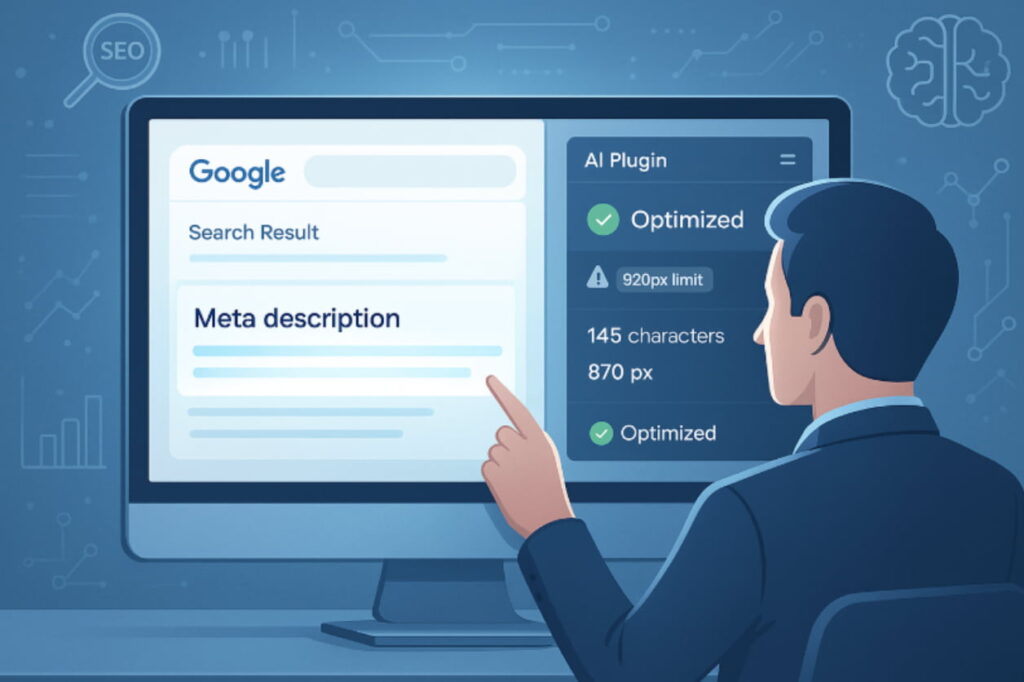
- Real-time character and pixel counters – Shows exactly how your description will display in search results
- Visual indicators – Color-coded warnings when you’re approaching or exceeding limits
- Bulk analysis – Identifies missing, duplicate, or problematic descriptions across your entire site
- Preview functionality – See how descriptions will appear on desktop and mobile
Advanced features:
- AI-powered suggestions – Generates optimized description options based on your page content
- Performance tracking – Shows click-through rates and identifies underperforming descriptions
- Keyword analysis – Ensures natural keyword inclusion without stuffing
- Competitor analysis – See what similar pages are using for inspiration
Popular SEO Plugins and Tools
Most major SEO plugins include meta description optimization:
- Yoast SEO (WordPress)
- Rank Math (WordPress)
- All in One SEO (WordPress)
- SEOPress (WordPress)
- Shopify SEO apps (for e-commerce)
These tools typically provide character counters, previews, and basic optimization suggestions.
Our Meta Description Optimization Plugin
Our plugin is specifically designed to take the guesswork out of meta description optimization. Here’s what makes it different:
Intelligent length checking:
- Calculates exact pixel width using Google’s actual font and rendering specifications
- Shows precisely which words would get cut off if you exceed limits
- Provides real-time feedback as you type with color-coded indicators
AI-powered recommendations:
- Analyzes your page content to generate multiple optimized description options
- Considers your target keywords, industry norms, and what drives clicks in your specific niche
- Learns from your site’s performance over time to refine suggestions
Bulk optimization:
- Review and update meta descriptions for dozens of pages in a single session
- Filter by page type, missing descriptions, length issues, or duplicates
- Accept AI suggestions or customize them to match your brand voice
Performance monitoring:
- Integrates with your analytics to track click-through rates
- Identifies underperforming descriptions and suggests improvements
- Allows A/B testing of different description variations
Seamless integration:
- Works directly within WordPress, Shopify, Wix, Squarespace, and other major platforms
- No switching between tools, optimize right where you create content
- Centralized dashboard for managing multiple sites
Whether you’re managing a small business website or an enterprise site with thousands of pages, the right optimization tool can save hours of manual work while ensuring your meta descriptions consistently meet professional standards.
FAQs About Meta Description Length
Let’s address some of the most common questions that people have when they’re working to optimize their meta descriptions. These answers should help clarify any remaining confusion and give you confidence in your approach.
What’s the ideal meta description length?
The most reliable guideline is 150-160 characters (approximately 920 pixels). This range ensures full display on both desktop and mobile without truncation.
However, the ideal length for your specific situation might vary. If your most important message can be communicated effectively in 130-140 characters, there’s no requirement to pad it out.
Critical tip: Front-load your most important information. Assume only the first 120 characters are guaranteed to display across all devices.
Does Google always use the one I write?
No. Google rewrites meta descriptions for 30-70% of search results, depending on the query. Google makes substitutions when it believes it can provide a more relevant snippet by pulling text directly from your page content.
You can improve the likelihood that Google uses your description by:
- Making sure it genuinely represents your content
- Addressing primary search intent for target keywords
- Writing well without being overly promotional or vague
How can I test if my meta description is too long?
The most reliable method is using an optimization tool that calculates pixel width using Google’s actual font specifications. Character count alone isn’t sufficient because different letters take up different amounts of space (W vs i, for example).
You can also manually test by searching Google for your page, but this has limitations because Google might not use your written description or might display it differently for different queries.
Should I write meta descriptions for every page?
Yes, for all important pages. Focus on:
- Homepage and main landing pages
- Top 10-20 highest-traffic pages
- All product/service pages
- Important blog posts and pillar content
For less critical pages (tags, archives), you can allow Google to auto-generate descriptions, though custom ones are always better.
How often should I update my meta descriptions?
Review and update your meta descriptions when:
- You update the page content
- Click-through rates are lower than expected
- Your target keywords or strategy changes
- At least annually as part of SEO maintenance
Conclusion
Meta descriptions occupy a unique position in SEO, they don’t directly influence rankings, yet they significantly impact whether people actually click through to your site. Getting them right requires balancing technical constraints with strategic messaging.
Key Takeaways
✓ Keep meta descriptions between 150-160 characters (approximately 920 pixels)
✓ Front-load your most important message within the first 120 characters
✓ Write unique descriptions for every important page
✓ Match search intent and accurately represent your content
✓ Include keywords naturally without stuffing
✓ Use specific value propositions rather than generic statements
✓ Avoid common mistakes: truncation, duplication, overpromising, keyword stuffing
Start Optimizing Today
The difference between a poorly optimized meta description and a great one can mean hundreds or thousands of additional visitors to your site each month. While the process might seem tedious, the right approach, combining strategic thinking with efficient tools makes it manageable even for large sites.
Start with your most important pages, apply the principles in this guide, and you’ll see better click-through rates and more qualified traffic reaching your site.
Ready to streamline your meta description optimization? Try our plugin and see how much easier it is to create perfectly optimized descriptions that drive real results.
Leave a Reply